

The $250K Skill Set Now Costs $0
Let me show you the whole ladder, rung by rung, and then I will tell you which rung you are standing on right now.

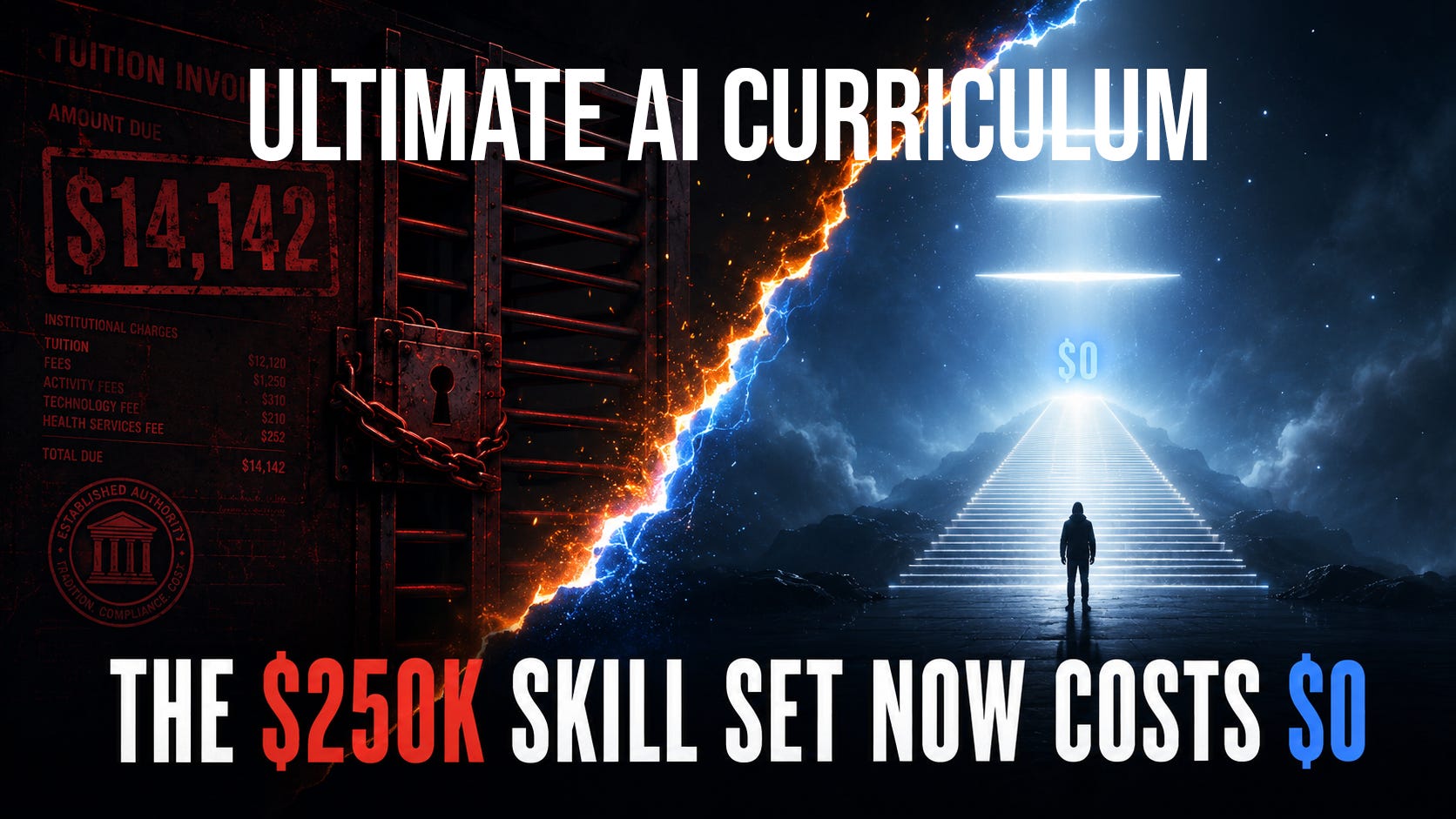
A coding bootcamp will run you about fourteen grand. Ai “influencers” will charge you to buy their course. However, a Stanford education in building large language models will run you nothing. Same skills. Same career outcome. Different price by a factor of infinity.
I want to sit with that for a second, because it is one of the strangest things happening in tech right now and almost nobody is saying it out loud.
The average coding bootcamp in 2025 cost $14,142 across more than 600 programs, with some running past thirty thousand dollars. Meanwhile, the exact curriculum that turns a curious person into a hireable AI engineer is sitting on YouTube and a handful of free course pages, fully public, taught by the people who literally built this field.
I have worked through pieces of this stack myself. Not the polished marketing version. The real thing, with the broken notebooks and the moments where you stare at a loss curve and have no idea why it will not go down. It works. And the job on the other side is real money.
Let me show you the whole ladder, rung by rung, and then I will tell you which rung you are standing on right now.
First, the money, because that is why you are here
The demand side is not subtle. LinkedIn ranked AI Engineer the number one fastest growing job in the US for 2026, with postings up 143 percent year over year. The average AI engineer salary hit $206,000 in 2025, a fifty thousand dollar jump in a single year. Senior people clear three hundred.
Here is the part that should make you put down whatever you are holding. PwC analyzed close to a billion job ads and found that roles asking for AI skills pay a 56 percent wage premium over the same role without them. That premium was 25 percent the year before. It is not flattening. It is widening.
And the supply cannot keep up. Demand for these roles outruns qualified candidates by roughly three to one, and most employers say they still cannot fill the seats. The world has a shortage of people who can do this, the pay reflects the shortage, and the training to fix the shortage is free.
That is the whole setup. Now here is the ladder.
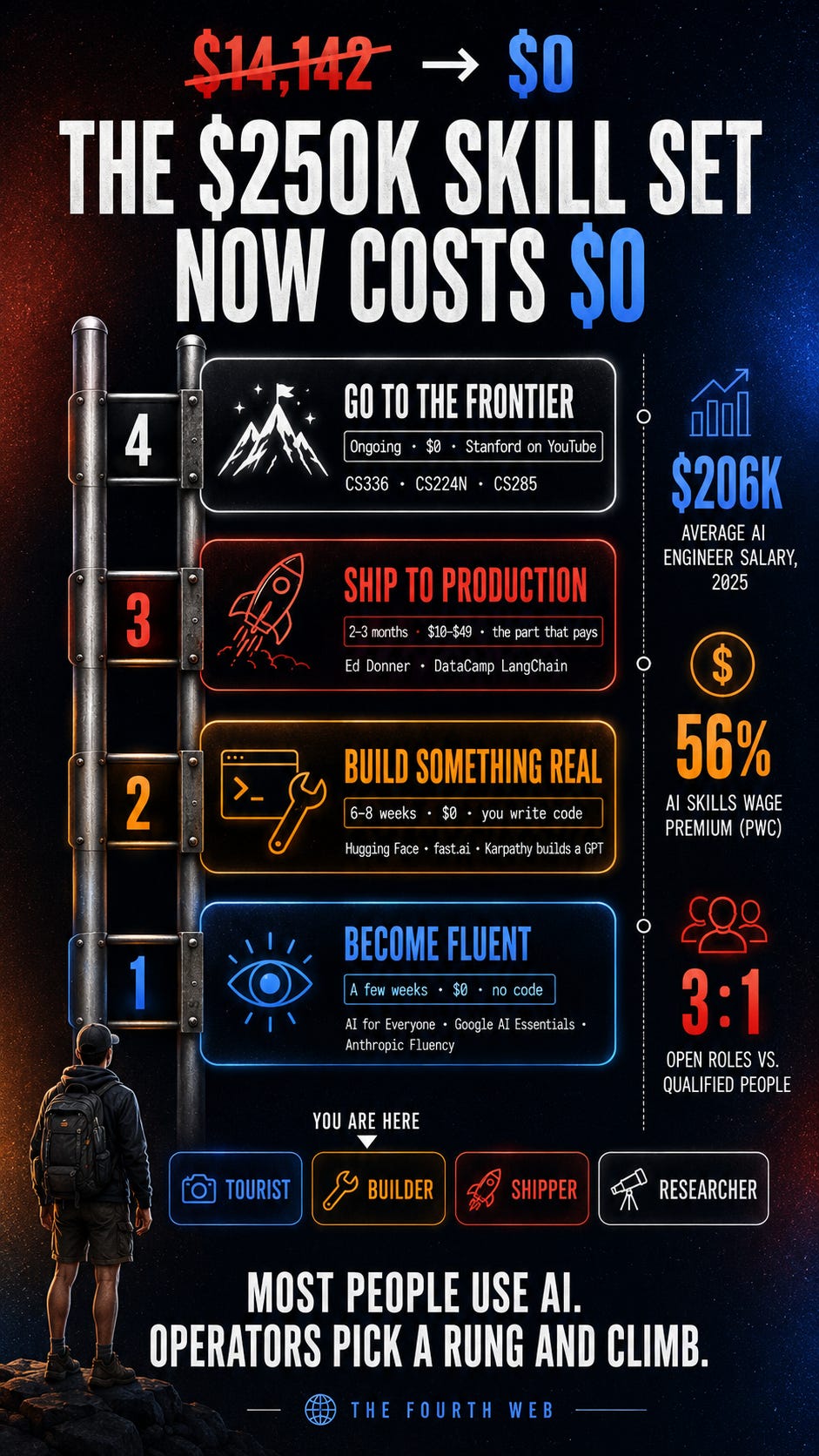
The ladder has four rungs
Everyone wants to skip to the top. Do not. The reason most people fail at this is not intelligence. It is starting on the wrong rung and drowning. Each rung below has a clear job, a few specific free resources, and a test that tells you when you are ready to climb.
Rung one: become fluent (a few weeks, $0)
You cannot build with a thing you cannot describe. The first rung is pure literacy. No code yet. Just a working mental model of what these systems are, what they can do, and where they fall on their face.
Start with Andrew Ng’s AI for Everyone. It is about seven hours, built for people who do not write code, and over two and a half million people have already taken it. Ng co-founded Coursera and basically launched the modern online learning movement, so you are starting at the source. If you are REALLY new to ai, try Joel Comm’s own AI for Everyone Show, which is a upcoming book launching in December.
Then run Google AI Essentials, a self paced set of short courses taught by Google’s own people, under ten hours, covering how these tools actually work and how to prompt them without fooling yourself.
Round it out with Anthropic’s AI Fluency course on Anthropic Academy. The Academy now lists around eighteen free courses, all with certificates you can drop straight onto LinkedIn. This one is the cleanest framework I have seen for thinking about how to actually work alongside these systems instead of just poking at them.
You have cleared rung one when you can explain what a neural network does to a smart friend, name three things AI is bad at, and write a prompt that gets a useful answer on the first try.
Rung two: build something real (six to eight weeks, $0)
Now you write code. This is where most of the magic and most of the dropout happens. The trick is to build before you fully understand, because understanding arrives through the building, not before it.
Take ChatGPT Prompt Engineering for Developers, a tight one hour course co taught by Andrew Ng and OpenAI’s Isa Fulford. It had over three hundred thousand signups in its first week, and it is the fastest way to go from prompting in a chat box to prompting through code.
Then the big one: the Hugging Face LLM Course. Twelve free chapters that walk you through the actual machinery, the Transformers library, fine tuning, and building real demos. This is the course that made the internals click for me.
If you want the deepest foundation, run fast.ai’s Practical Deep Learning by Jeremy Howard, the former president of Kaggle. Nine lessons, no advanced math required, and the course literally promises to teach you the calculus and linear algebra as you need it. It runs on free cloud compute, so you do not even need a fancy machine.
And here is the rung two power move. Watch Andrej Karpathy’s Neural Networks: Zero to Hero. Karpathy was a founding member of OpenAI, ran AI at Tesla, and built Stanford’s computer vision course. In this free YouTube series he builds a neural network from nothing, in plain Python, and then builds a tiny GPT from scratch in front of you. His “Let’s build GPT” video is the single best two hours of AI education on the internet, and it costs you nothing but attention. As a side note, Karpathy joined Anthropic’s pretraining team in May 2026, which tells you something about where the people who teach this stuff end up.
You have cleared rung two when you have fine tuned a model and deployed a working demo someone else can click on.
Rung three: ship to production (two to three months, $10 to $49)
Building a demo and shipping a system are different sports. Rung three is where you learn the unglamorous parts that actually pay: retrieval pipelines, fine tuning that holds up, agents that do not fall over, and the monitoring that keeps it all alive.
The anchor here is Ed Donner’s LLM Engineering course on Udemy. Eight weeks, eight real apps, covering RAG, QLoRA fine tuning, and autonomous agents. Donner was a managing director at JPMorgan who led three hundred engineers before founding his own AI company, so this is production wisdom, not theory. The course lists at a hundred twenty dollars but is almost always on sale for around ten, and the entire course repo is free on GitHub if you want to peek before you pay.
Pair it with DataCamp’s AI Engineering with LangChain track, six courses built with the LangChain team covering evaluation, tool use, and agent systems with LangGraph. This is the operations layer, the part that separates a cool weekend project from something a company will actually run.
You have cleared rung three when you have shipped an autonomous agent and can talk about evaluation and monitoring without bluffing.
Rung four: go to the frontier (ongoing, $0)
This is the rung almost nobody reaches, and the fact that you can reach it for free is the most absurd part of this whole story.
The crown jewel is Stanford’s CS336, Language Modeling from Scratch, taught by Percy Liang and Tatsunori Hashimoto. It was built because, in Liang’s words, researchers were becoming detached from how these models actually work, so the class makes students build every single piece. All nineteen lectures from the 2025 run are free on YouTube, and the five assignments take you from writing a tokenizer to running reinforcement learning on a real model. There is nothing else like it.
From there the frontier opens up, all free, all on YouTube. Stanford’s CS224N for natural language processing. CS236 for the generative models behind image and video tools. CS234 and Berkeley’s CS285 for reinforcement learning. And David Silver’s classic DeepMind reinforcement learning series, the ten lectures from the person who led the team that built AlphaGo.
You have cleared rung four when you can read a fresh research paper, understand the architecture, and have an opinion about whether it will hold up.
The detail nobody is talking about
Here is the turn. While you are climbing this ladder, look at who else is on it.
The learners now include the agents.
Anthropic’s catalog does not just teach you to use AI. It teaches you to build subagents and agent skills, software that goes off and does work on its own. Coursera now uses AI to translate and personalize its courses at a scale no human faculty could touch. The same agent patterns you will learn to build in rung three are already being used to deliver the education in rung one.
Read that again. The people learning to build agents are being taught, in part, by agents. The tools are teaching the next generation to make better tools. That loop is the actual story here, and it is moving fast.
This is the part the bootcamps cannot price, because it is not a course. It is a shift in who participates. For the entire history of the internet, software was something humans made and humans used. That line is dissolving. The web is becoming a place where humans and agents both read, both write, both build. The skills on this ladder are not just a path to a job. They are a passport into the version of the internet that is actually coming.
So which rung are you on
Every reader of this falls into one of four spots. Find yours. Then take the next step today, not Monday.
You are a Tourist if you read about AI but have never built with it. Your move is rung one. Open AI for Everyone before you close this tab. The whole thing is a few weeks and it changes how you see everything else.
You are a Builder if you can prompt well and want to make things that work. Your move is rung two. Watch Karpathy build a GPT from scratch. By the end of one video you will understand more than most people who talk about this for a living.
You are a Shipper if you can build but want to get paid to put things in production. Your move is rung three. Ten dollars and eight weeks of Ed Donner stands between you and the part of the market that pays two hundred thousand.
You are a Researcher if you ship already and want to work at the edge. Your move is rung four. CS336 is sitting on YouTube right now. The only thing standing between you and a Stanford LLM education is whether you press play.
The bootcamps spent a decade convincing everyone that this knowledge was worth fourteen thousand dollars and lived behind a paywall. That was true once. It is not true anymore. The toll booth is gone and most people have not noticed.
The gap that matters now is not money. It is not access. It is whether you start climbing.
Most people will read this and bookmark it. Operators will pick a rung and move.
Which one are you?
If this was useful, the visual edition with the full clickable ai curriculum lives on fourthweb.ai.
Forward this to the one person you know who keeps saying they want to get into AI but does not know where to start. You just handed them the whole map.
Well, maybe Coursera was getting too many signups for free because they are now charging $49 for Andrew Ng's AI for Everyone course.