

OpenAI Just Turned ChatGPT Into GPT-Commerce? Amazon is Worried.
OpenAI's Instant Checkout feature is changing the game of online shopping.

Something strange happened yesterday. The kind of thing that makes you stop mid-scroll and realize you’re witnessing a genuine shift, not just another tech announcement that’ll be forgotten by Thursday.
Remember when buying something online meant opening five tabs, comparing prices across three websites, reading seventeen reviews, abandoning your cart twice, and finally completing checkout after entering your credit card information for the hundredth time? That entire ritual just became optional.
OpenAI launched Instant Checkout in ChatGPT this morning. The interface is almost boring in its simplicity. You ask the AI for a product. It recommends something. You click buy. You pay. Done.
No tabs. No redirects. No Amazon middleman. The entire shopping journey collapsed into one conversation.
The Shift Nobody Saw Coming
Here’s what actually changed today. OpenAI took their 700 million weekly users and gave them the ability to complete purchases without ever leaving the chat window. Right now, it works with Etsy sellers and over 1 million Shopify merchants including brands like Glossier, SKIMS, Spanx, and Vuori. But that’s just the beginning.
The technology underneath is called the Agentic Commerce Protocol, built in partnership with Stripe. OpenAI open-sourced it this morning, which means this isn’t really a ChatGPT-only feature. It’s infrastructure. Any merchant can integrate with it. Any AI platform can build on it.
What struck me about the demo was how unremarkable it felt. Which is exactly why it matters.
You ask ChatGPT: “Show me hiking boots under $150.” It surfaces options with reviews and pricing from across the web. You see one you like, tap “Buy,” confirm with Apple Pay, and move on with your day. The friction just disappears.
E-commerce used to mean discovery happening on Google, comparison happening across multiple tabs, and checkout happening on Amazon or wherever you built up enough trust to save your payment details. Now it’s just a conversation with an AI agent that can see it through from question to delivery confirmation.
Why This Terrifies The Giants
There’s a reason Amazon has been frantically blocking AI crawlers from accessing its product data. When you search for Amazon products in ChatGPT now, you get recommendations from Walmart, Target, and independent merchants instead.
Amazon’s referral traffic from ChatGPT dropped 18% in August.
Meanwhile, ChatGPT now drives 20% of Walmart’s total referral traffic.
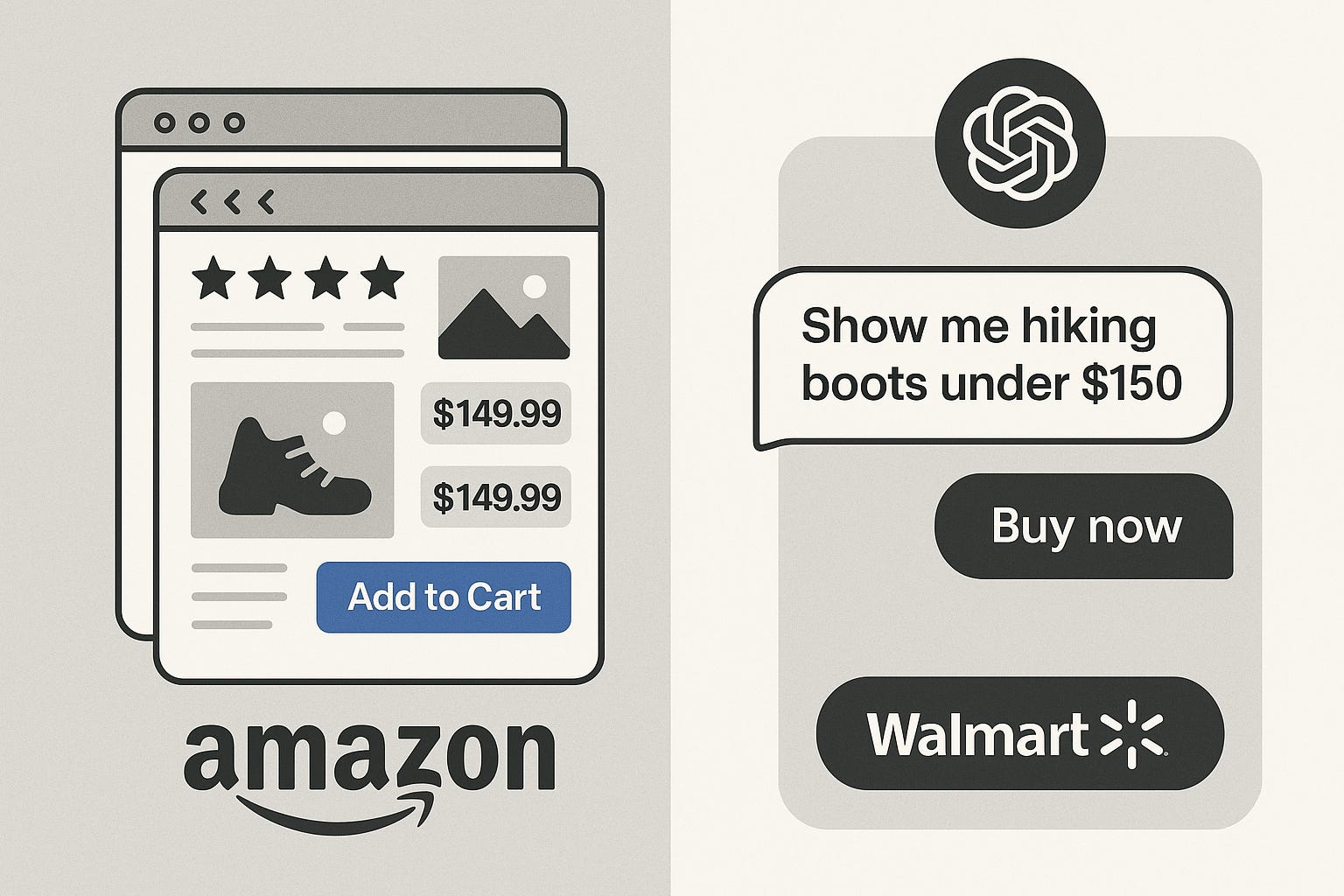
Think about what that means. Amazon built a $56 billion advertising business on one fundamental assumption: that they control the browsing experience.
Merchants pay billions to show up in Amazon’s search results because that’s where shopping intent converts to sales. But if shopping intent starts and ends inside an AI conversation, Amazon’s entire model breaks down.
Recent data shows that 2% of all ChatGPT queries involve shopping. That sounds small until you realize it’s 50 million shopping questions per day. Billions of dollars in purchase intent already flow through these conversations.
OpenAI just figured out how to capture the transaction value.
Google faces an even more existential problem. Their entire business model depends on sending people away from Google to merchant websites, monetizing that click with search ads.
But if the purchase completes inside ChatGPT there’s:
No click to monetize.
No ad to display.
No referral to track.
The transaction happens in a space Google doesn’t control, using infrastructure Google didn’t build
The power in e-commerce is shifting from whoever owns the marketplace to whoever controls the conversation.
The Trust Problem That Could Break Everything
But here’s where it gets interesting. And complicated.
When AI agents start making purchases on your behalf, trust stops being a nice-to-have and becomes the only currency that matters. Because once you authorize an AI to handle transactions, you’re creating attack surfaces that didn’t exist before.
What happens when an agent buys something you didn’t actually approve? What if fraudsters figure out how to inject prompts that reroute your payments to their accounts?
What if the recommendations ChatGPT surfaces carry hidden bias toward merchants who pay higher fees? What if your AI shopping assistant decides it knows what you need better than you do?
This isn’t paranoia.
It’s the reality of delegating financial authority to software that operates in natural language. The fraud patterns we’re used to defending against were built for humans clicking buttons.
Now we need systems that can verify whether an AI agent has been compromised, detect when synthetic identities are trying to open accounts, and monitor conversations in real-time to catch manipulation before money moves.
This is exactly why companies like Oscilar suddenly matter more than ever.
Oscilar builds fraud detection infrastructure specifically designed for agentic commerce. Their platform doesn’t just look for stolen credit cards. It verifies agent identity. It detects when an AI’s behavior doesn’t match the actual user behind it. It spots synthetic identities at the moment they try to onboard. It analyzes transaction patterns in milliseconds and flags the ones that look wrong in ways traditional fraud tools would miss entirely.
Research from Visa found that 88% of consumers worry about AI being used to commit fraud. But 85% are fine with their bank using AI to prevent it, as long as there’s transparency about how it works.
The gap between those two numbers is where companies like Oscilar operate.
Without this invisible layer of risk infrastructure running underneath every AI transaction, agentic commerce doesn’t scale. It breaks. Because the first time someone’s AI agent gets compromised and drains their account, trust evaporates faster than it took to build.
What This Means If You’re Building Something
If you’re a merchant trying to figure out what this means for your business, the question isn’t whether AI commerce happens. It’s whether you’ll be visible when it does.
This isn’t SEO anymore. It’s GEO: Generative Engine Optimization.
Your product descriptions, customer reviews, and structured data matter in new ways because AI agents are reading all of it to make recommendations.
If you’re building a company, the shift to AI agents as the primary interface between customers and commerce changes almost everything about how you think about distribution.
The question stops being “how do we get traffic?” and becomes “how do we build trust into AI interactions?”
If you’re investing, watch the infrastructure layer that makes all of this possible. Payment processing, fraud detection, identity verification, and risk management for AI commerce are all getting rebuilt from scratch.
The companies that solve trust at scale will capture enormous value.
The Invisible Guardrails That Matter Most
Instant Checkout might end up being OpenAI’s killer feature. The thing that transforms ChatGPT from a helpful assistant into essential infrastructure for daily life.
But its success depends entirely on systems most people will never see or think about. Fraud scoring running in the background of every transaction. Agent verification happening between the moment you click “Buy” and when the payment processes. Contextual risk analysis making split-second decisions about whether this purchase looks legitimate.
That’s the moat for the next wave of FinTech. Not the flashy features users interact with directly. The invisible guardrails that make trust possible at scale.
The browser didn’t die overnight. But yesterday morning, we watched the beginning of the end.
Shopping is moving from tabs to conversations.
From clicking through multiple sites to just asking a question.
From Amazon’s walled garden to open protocols that any AI agent can use
The companies that win this transition won’t be the ones with the best products or the lowest prices. They’ll be the ones that build the most trustworthy AI agents. Because once AI starts spending your money, trust is the only thing that matters.
And trust, it turns out, is infrastructure.
What do you think? Will you trust ChatGPT to buy things for you? Hit reply and let me know.